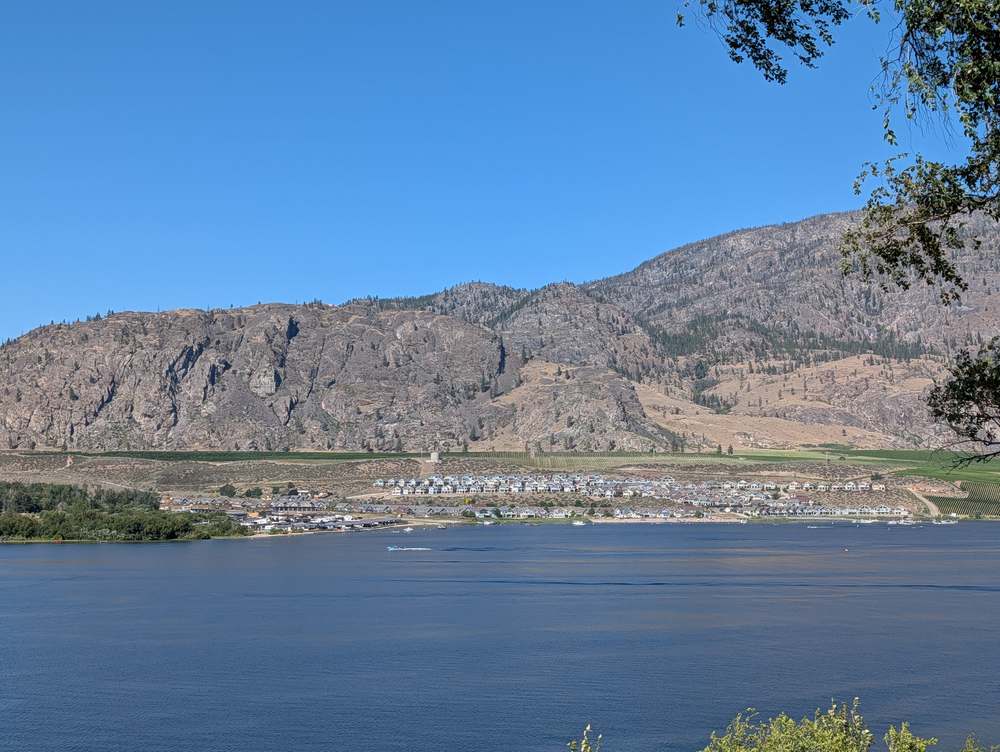
What your Lower Mainland equity actually buys here, the one-agent advantage of a BC-to-BC move, and the taxes you leave behind the moment you cross the Coquihalla or Highway 3.
Vancouver and the Lower Mainland are some of the most expensive real estate markets in the country. That's bad news if you're trying to buy your first home there — but it's the single biggest advantage you have if you're willing to relocate. Equity built in Vancouver goes a long way in the South Okanagan.
The pattern Pat sees most often: a Lower Mainland homeowner, often approaching retirement or newly remote-capable for work, who realizes their existing equity could fund a meaningfully different lifestyle two provinces away — except it's not two provinces away. It's still BC, just five hours down the highway.
Compare this to a move from Alberta or Ontario: no driver's licence exchange, no healthcare coverage gap, no vehicle re-registration, no new provincial tax residency clock to start. Your BC driver's licence, your MSP coverage, your ICBC-insured vehicle — all of it stays exactly as it is.
Mostly logistics, not bureaucracy: selling one home, buying another, coordinating a moving truck, and picking the right community. The government-paperwork side of relocating — the part that trips up out-of-province buyers — is almost entirely absent for a BC-to-BC move.
Enter your details below and the rest of this guide unlocks immediately — plus you'll get a copy emailed to you for reference.
Real estate prices move constantly in both markets, so treat the comparison below as a starting point for a real conversation, not a quote. What tends to surprise Lower Mainland sellers is how far the gap actually stretches — a modest condo or townhome in Metro Vancouver can translate into acreage, a lake view, or a vineyard-adjacent property outright, with no mortgage at all, in the South Okanagan.
A two- or three-bedroom condo or townhome in Metro Vancouver, no outdoor space, shared walls, strata fees.
Depending on the year and inventory, a similar sale price can mean a detached home with a pool, a vineyard-view acreage, or a lakefront property — often purchased outright, freeing up monthly cash flow entirely.
Every situation is different depending on what you're selling and current South Okanagan inventory. Because Pat handles both sides of a BC-wide transaction personally, he can walk you through real numbers on both ends — not a generic estimate.
Most real estate licences in BC are effectively regional in practice — an agent who knows Vancouver well typically isn't the one who knows Osoyoos, and vice versa. Selling in one market and buying in another usually means working with two separate agents who've never spoken to each other, coordinating two closings across two brokerages.
With offices in both Coquitlam and Osoyoos, Pat can list your Lower Mainland property and represent your South Okanagan purchase — the same person, the same file, coordinated timing on both closings. That matters most when you need your sale proceeds to fund your purchase without a gap, or when you'd rather not explain your situation twice to two different agents.
This isn't a small convenience — it's the reason Pat built his practice around exactly this kind of move. If your situation involves selling here and buying there, at the same time, this is the scenario his whole business is set up to handle well.
If you currently own a Vancouver property subject to the city's Empty Homes Tax (roughly 3% of assessed value on vacant residential properties within city limits), that bylaw doesn't exist anywhere in the Okanagan. It's a City of Vancouver-only tax and stays behind when you move.
If a property you own currently falls inside a designated SVT area (which includes Metro Vancouver), you may already be familiar with this annual tax. Osoyoos and Oliver are outside the province's designated SVT area entirely — there's nothing to declare on a property there.
Unlike the two taxes above, the BC Home Flipping Tax applies province-wide with no geographic exemption — Osoyoos and Oliver included. If there's a chance you'd sell within two years of buying, this one still matters wherever you are in BC.
If your Vancouver property is your principal residence, selling it typically doesn't trigger capital gains tax federally — but if you own a second property, or if your situation is more complex, confirm your specific tax picture with an accountant before you list. Our BC Tax Guide covers PTT, GST, and all of the above in full detail, with a calculator for your specific purchase price.
Most Vancouver-to-Osoyoos moves run via Highway 3 through Hope and Manning Park, roughly a 4-to-4.5-hour drive in good conditions — noticeably shorter than an Alberta relocation, and without a provincial line to cross.
Pat can list and manage your sale directly, coordinating timing with your South Okanagan purchase from day one.
Ideally with financing (or a subject-to-sale condition) structured around your Lower Mainland closing date.
The advantage of one agent on both sides — timing the sale proceeds to land before or on your purchase closing, minimizing bridge financing or double-carrying costs.
A same-province move with a much shorter drive and none of the paperwork that comes with crossing a provincial line.
Our Relocation Guide covers the full moving checklist if you want the complete version.
Lower Mainland buyers often arrive with "Osoyoos" as shorthand for the whole region — but the towns and areas nearby have real differences worth understanding before you commit.
The lake town itself — beaches, restaurants, and the warmest summers in Canada.
Wine country — vineyard living, a quieter pace, still close to Osoyoos.
Acreage, privacy, and views above the valley — a short drive to town.
Smaller, more rural, and often more affordable — worth a look if budget is the priority.
Our Communities Guide breaks each of these down in full, including our Living in Osoyoos Guide and Living in the South Okanagan Guide for a deeper look at day-to-day life in each area.
A couple nearing retirement sells their Coquitlam townhome and buys an $850,000 vineyard-view home in Oliver as their principal residence. Both have lived in BC for well over 12 months.
Illustrative example — not a specific client. See our BC Tax Guide for the full calculator.
For a BC-to-BC move, the tax picture is usually the simplest part of the whole process. The real value is in coordinating the sale and purchase so proceeds land where they need to, when they need to — which is exactly what having one agent on both ends is built to solve.
Pat can handle both sides of your transaction personally — one agent, one coordinated timeline. Let's talk through your numbers and your timing.